| |||||||||
 | | | | ||||||
|
Is there an information explosion coming? Yes, and it's based on two major factors. First, there's all this sensor and RFID information that's starting to flow into corporations, and it will only accelerate; Wal-Mart is looking at 5TB to 7TB a day. The other factor is that unstructured information makes up 80% to 90% of the average corporation's information content. It's not in a form computers can readily use, such as e-mail. We are using context-sensitive text mining as a tool for structuring that content. When you do that, all that information becomes a corporate asset.
How might that new asset be used? Most of the new information that allows you to predict the future is nontraditional corporate information -- what we call indicator information. You have transactions, which are past; you have events, which are current; and you have indicators, which are not traditionally used in business. You can put that information in a data mine and after the fact try to figure out what you should have done. Or you can feed it into a cause-and-effect model ... and use pattern-recognition technology. [That gives you] the ability to understand patterns of business activity that are going to repeat and say, "What do I want the outcome to be?"
Can you give a couple of examples? Weather predictions for a warmer-than-usual winter in New England change the model's probability of selling x fruitcakes to y. That, coupled with a colder-than-normal forecast for the mid-Atlantic states, drives a directive to channel the fruitcake to those states.
What are some opportunities for IT in the mobile world? Mobile workers are the orphans of the information revolution, because IT has basically ensconced itself in a stationary environment. Mobile workers work asynchronously with their IT. The office worker works the problem with the computer, but the mobile workers for the most part get their information, go out and do their work, come back and report their information. The IT is not overlaid directly on top of their work.
We have built a testbed called process mentor. It's the ability for you to deliver just-in-time information to the mobile worker. Information flows, unprompted in some cases, as you need it.
Can you give an example? In the petroleum industry, 70% of workers are in the field. The average age of a field worker is 55, and 50% of them will retire in the next five years. That's a hell of a lot of expertise not easily replaced. So if I'm out at the wellhead and I ask, "How do I take this thing apart?" all of a sudden I have just-in-time training that tells me exactly how to do it. It says, "Here's Step 1 -- now do it. Now here's Step 2 -- do it," and so on. It's the opportunity to put IT into the business process rather than work around the business process.
Where will we see sensors deployed? That airplane that's flying has sensors that tell me that a certain part is going to go out, so I can fly the part to the destination before the plane gets there. That's the kind of model that's going to be deployed throughout all of business. All the items coming into my supply chain, all the items going through manufacturing, all items going out to the customer and all the people in my organization are going to be sending me information.
All that extra data must have huge implications for storage systems. When we start sending petabytes of information from one company to another, it's cheaper to have a petabyte storage cube put on an airplane and fly it to the other coast. That will be a constraint in the future, because petabytes of information don't work well on our communications infrastructure.
What's the solution to that problem? The amount of information that can be stored on a hard drive doubles every year ... and fiber-optic capacity is doubling every nine months. While it will take some time, this will overcome the problem. Also, you can break the file into many pieces, transmit the pieces and put it all together on the other end. The problem here is the infamous last mile. Most companies do not have [networks] to allow them to send the data through multiple pipes from a single source and to a single destination. This is an infrastructure design problem that never contemplated needing many T3s to the same point of origination/delivery.
Profile Name: Jeff Wacker Title: EDS fellow and futurist Company: Electronic Data Systems Corp. Background: Wacker is chief technology officer for EDS's Global Industry groups. He earned a bachelor's degree in computer science and an MBA from the University of Nebraska. He is a member of MIT's Society of Learning. |
13 January 2006


06 January 2006
"The New BrandScape: Six Future Trends Changing Marketing"
by Mary Brown
May 17, 2005
Someday in the not-so-distant future, branding as we know it will be thought of as so 20th century. With societal, cultural and technological changes occurring at increasingly accelerated rates, keeping your eye on the horizon of future trends in branding gives your company the advantage.
Peter Bishop, executive director of the Institute for Futures Research, points out that you can't predict the future but you can arrive there less surprised and more prepared by telling stories, thinking the unthinkable and creating alternate futures through scenarios. Nine out of the 10 scenarios you imagine won't come true. But you'll be ready when that one vision does become reality.
What trends are already reshaping our ideas of branding?
1. Consumers Are the New Creative Directors
Brands that create a process of discovery drive passion and ownership of the brand. Consumers like being the creative director and feeling in control of shaping the products and brand. Born from consumers' desire to differentiate themselves from the mass market, this trend toward customization will continue to grow with the flexibility and efficiencies offered by technology at home and in manufacturing.
Consider Timberland's BOOTSTUDIO, where you can 'build a boot as original as you are,' including adding your own monogram. Nike ID also allows customers to control the look of 27 footwear styles and view their final creation from five different angles.
Lab21 takes customization to new heights by creating individually formulated skin-care products based on your DNA. Customers take an at-home DNA test and answer a questionnaire about the health of their skin. LAB21's Skin Profiler System then creates a custom formula (with your name on the label) to treat specific conditions.
As diamond promoters encourage women to buy their own diamonds (why wait for a marriage proposal?), technology that allows a gal to design her own diamond ring in three easy steps is sure to increase sales. Diamond.com not only builds your custom ring but also clearly educates on the four Cs, grading reports, setting styles and how to find your ring size.
2. Cynicism Raises the Bar for Authenticity
With consumer cynicism about marketing at an all-time high, brands must cultivate authenticity on a level never demanded before. Consumers are smart, resourceful and savvy. If your brand doesn't deliver on all its promises, or fails to speak to a consumer's specific, personal needs, your brand will become irrelevant, or worse: a pariah.
Furthermore, the companies behind a brand will be expected to behave authentically and demonstrate an active alignment with consumers' values. Simply slapping a pink ribbon on your Web site will no longer cut it, especially in building brand relationships with the influential woman consumer.
This demand for authenticity will shift marketers' preference for communicating via advertising and direct mail. The overt sales focus inherent in these channels makes them more suspect in consumers' minds.
Conveying brand messages via third parties, especially if they are a trusted, impartial source, will be better received. We'll see an increase in brands using the more transparent channels of public relations, sponsorships, niche interaction, word-of-mouth/buzz and blogs to deliver seemingly unbiased brand communications.
3. Multitasking and Info Overload: Don't Waste My Time
In a 2004 Redbook magazine poll of 1,000 women, a majority actually preferred time to money. In our info-saturated, multitasking lives, time is the new currency.
Barraged by more information than we can ever hope to absorb, we have what Paco Underhill, author of Why We Buy, refers to as a process crisi —how do we get the wisdom out of all the data with the least amount of time investment?
Consumers look to companies, media and marketers to provide information filters—tools to edit the mass amount of data available. As Robyn Waters, trends guru and former VP of Trend, Design and Product Development for Target, points out, "too much information without editing is toxic."
To effectively filter and communicate relevant data to a specific consumer, brands will need to be well versed in the art and science of interpreting, translating and delivering information. This requires cultural, ethnic, gender and generational expertise as well as sophisticated global knowledge of word associations and linguistics.
Amazon.com's highly developed preferences filtering keeps track of your interests, making recommendations based on your ever-growing profile, providing product reviews, updating daily a customized list of the newest and coolest products customers are buying—essentially creating a personal shopper to save you time. And it does all this in six languages with the appropriate cultural insights for each.
4. Humanization of Technology
The mind-bending advancements of the Web and computer technology have thrown life into warp speed. From an evolutionary standpoint, technology has infiltrated every aspect of our lives faster than we can assimilate the changes. Programming the clock on your old VCR seems effortless compared to the overwhelming, and often intimidating, technological knowledge now required to efficiently get through a day.
Successful brands will "humanize" technology by delivering a brand experience where the technology is transparent to the consumer. Products, services and communications fashioned around innate human behavior, instead of the ideals of a programmer, will win consumers.
Hewlett-Packard leads the pack with its "you + HP" consumer brand campaign focused on taking the hassle out of digital photography. Visually fun, full of creative energy and real life scenarios, HP's ads devote minimal space to showing actual product. Instead, they go to the heart of image-making—documenting, sharing and making memories. HP touts its digital cameras and printers as "radically simple picture-making technology, which lets you be in control of the entire picture-making process." It back ups its claim with easy-to-navigate, thorough product support via hp.com.
5. From Multi-Channel to Uni-Channel
Donald Libey, considered the leading direct marketing and catalog industry futurist, predicts that we will see even more evolved information systems than the World Wide Web. Any aspect of communications in our lives—cell and landline phones, libraries and research, bill paying, satellite TV, GPS navigation, entertainment, travel, financial transactions, shopping, fitness and health monitoring—will be available from anywhere at any time.
Increasingly, consumers will be less aware of separate marketing channels. Instead, all experiences of brand communications will be perceived as one all-encompassing, 360-degree, 3-D channel. Brands can prepare now by investing in creating a consistent and integrated customer experience across today's communications channels.
Catalog and retail giant JC Penney understands how to fully leverage multiple-channel synergy. Its stores, catalog, Web site and advertising interrelate across all channels: enter your zip code on jcpenney.com and browse your local JC Penney store's sales flyer or download coupons; order a printed catalog or flip through one online; items purchased through any channel can be returned or exchanged via any channel. At any touchpoint of the brand, the consumer finds a consistent experience.
6. Trends in Trending
While attending the 9th Annual Future Trends Conference, I was struck that one scenario in particular was not addressed more fully—the phenomenon that the mature market, AKA aging baby boomers, will completely redefine what "old" and "aging" means.
With the average American now living about 30 years longer than 100 years ago, what's considered old? What's considered middle-aged, for that matter? If the brands in these consumers' lives rely on the stereotypical notions of older as an uncool, has-been demographic, they'll perish.
Marketers have historically looked to the 18-to-24 year-old crowd for inspiration and indicators of future trends. I'd challenge the next conference, and brand stewards in general, to explore the dynamic, trendsetting potential of the baby boomer powerhouse.
MarketingProfs.com
Mary Brown is president of Imago Creative. For more information, visit www.imagocreative.com.
"
02 January 2006
By JOHN MARKOFF
Nanotechnology is officially on the road map.
A handful of futuristic chip-making technologies at the atomic scale have been added to an industry planning effort that charts the future of the semiconductor manufacturing industry every two years.
The transition to a post-silicon era is forecast in a report called the International Technology Roadmap for Semiconductors, to be issued Saturday. The report, which is produced cooperatively by semiconductor industry associations from Europe, Japan, Korea, Taiwan and the United States, is used by the semiconductor industry as a planning tool to determine how best to spend research and development money for new technology.
The shift away from conventional silicon transistors has become an important part of the industry's thinking, though the use of nanotechnology is not expected to replace current chip-making processes for another decade.
The urgency in moving to molecular electronics is propelled in part by a recognition that conventional technologies, despite significant advances, will not be able to sustain indefinitely the chip industry dictum, known as Moore's Law, that projects a doubling of computing power roughly every two years.
In recent years, the semiconductor industry has repeatedly found ways to make convent"
30 November 2005
Troubled AMP finds the pursuit of innovation pays dividends in improved staff engagement. Unleash the ‘intrapreneur’ and boot up the ‘conversation cafes’.
Lee Barnett, CIO, AMPThere has been precious little good news for embattled Aussie icon AMP of late. Its share price plummeted from a high of more than A$19 in March 2001 to now hover around the A$5 mark.
AMP’s story is not unique. Rather, it has joined a long list of Australian corporations undone by failed global growth strategies. The company is now de-merging from its under performing UK operations, now called Henderson, aiming to raise A$2 billion and write down A$2.6b in assets in the process. But earnings outlooks from CEO Andrew Mohl remain bleak.
While these corporate strategies are being played out in boardrooms and regulators’ offices in the UK and Australia, at the coalface here, AMP is following through on an innovation initiative instigated by former CEO Paul Batchelor.
Sparks of genius are random and unpredictable, yet many organisations seek a formula for innovation to help them stand out from their competitors. For most, applying a formula is as far as they go but while many companies pay lip service to innovation, a few have gone a step further to create a culture of innovation. They include Carter Holt Harvey in New Zealand, Hydro Tasmania, TAFE in the Hunter Valley and AMP Financial Services (AMP).
Early last year, AMP began putting together the ingredients for creative thinking in a move that has already demonstrated some promising results. Among them is an estimated 100 per cent return on investment, a staff engagement of 25 per cent and a coveted finalist’s position in the MIS Innovations Awards 2003.
Considering the payback, AMP’s move to become more innovative was timely. The company’s innovation program has injected an upbeat mood during a period of unsurpassed anxiety in the workplace.
Head of innovation Annalie Killian says the project had a slow beginning because of this.
“There was a lot of fear and worry around that created a lot of noise, so it was hard to engage people often,” she says, although she adds that change is hard to implement even in boom times.
“Getting the innovation wheel cranking is damn hard. Many organisations run this only as part of research and development,” says Killian. “Here we are trying to get it as part of the organisational culture – and this is fairly new in Australia.”
CIO as champion
The project began when former chief executive Paul Batchelor asked a team of senior executives to examine best practice in innovation around the world. AMP’s CIO Lee Barnett was one of the team and became its champion.
“I decided innovation was important – not just the ideas but what it does to enhance a culture and foster collaboration and staff engagement, especially when that culture is risk averse,” she says.
As a result, Barnett set up a small unit to spearhead innovation within the IT department, with the blessing of AMP’s managing director, Craig Dunn. It is seen as a test-bed for other departments, although Barnett says AMP is unlikely to consider expanding the initiative before early next year.
Although it was simply fortuitous that the innovation program was seeded in the IT department, Barnett says it offers a great value proposition for technology.
“In AMP, IT has been through an enormous amount of change in the past few years,” she says. “The IT investment bubble has burst so people have to be smarter and cleverer about the way you work at the front end, to manage with a lower budget.”
AMP has also experienced significant headcount reduction due to reduced project spend in IT.
Tight unit
Against this background, Barnett set up the unit with a budget of just A$50,000 and a staff of two – head of the unit, Annalie Killian, and a full-time engagement officer. Killian was appointed to the role alongside her responsibility for employee communication and also recently inherited the Knowledge Sharing function.
“There is a logical fit and overlap among these functions – they are complementary,” she says. “It’s really about how we return greater value from our intellectual assets, both people and systems.”
Despite the financial constraints, working on the smell of an oily rag had some benefits. Killian says if she had been allocated a “fat” budget she would have taken a different route that may not have been sustainable during lean times.
“It has been constraining but it has forced us to think differently,” says Killian. “Because we didn’t have a huge budget, we were forced to be innovative to get more mileage and that resulted in us being more sustainable.
“I’ve worked before in organisations that employed in-house consultants for special projects and as soon as the business contracted, the whole project imploded,” she says. “What we really needed was to drive this through people’s normal day jobs.”
Essentially, Killian aimed to engender a culture that was by nature innovative so that it didn’t have to be shored up by costly coaches and other third parties.
“I saw my brief as making innovation top of mind and systemic for AMP to the point that it penetrates the consciousness of everyone and gives them an opportunity to innovate in their everyday jobs in a way that’s woven into their daily activities.”
She took suggestions from a report put out initially by the executive team that identified common traits and drivers for innovation around the world, with pointers to how it may be implemented in AMP.
A key recommendation was ‘intrapreneurship’ or the creation of mentors who would champion change in the business. These are volunteers who offer to undertake the role of mentor on top of their normal jobs.
Most are selected from middle management because they have the benefit of both practical skills and a big picture view of the business, says Killian.
Volunteers are given special training in creativity once a fortnight that includes programs from thinking skills specialists such as Edward de Bono, Mind Mapping and Zing.
Innovation evolution
Aside from this, the program has evolved rather than followed a roadmap, according to Barnett. “It has been something of a journey – there is no instant answer,” she says.
Killian began the evolution by turning the wheel of ideas.
“Innovation is very random and unpredictable. You can’t bottle it or create a recipe for it,” she says. “But one of the ways of letting innovation happen organically is to get people from different disciplines to spark one another off. A logical starting point is to create mechanisms for ideas to be heard and acted upon.”
A critical aspect for success is the forums should provide a safe environment to air new ideas.
“Trust is fundamental because there is a huge element of personal risk taking and failure involved,” says Killian.
To start with, AMP’s Web development team created an intranet-based capture and tracking tool, which was called Circul8, as a forum for ideas and suggestions.
Killian then stipulated a proviso for posting ideas: each suggestion must be accompanied by a quick one-page business case and the author has to take responsibility for pushing it through to its conclusion. “That focuses people on thinking the idea through,” she says.
Once accepted, the author is assigned an intrapreneur because, says Killian, “we recognise it is hard to implement new ideas and cut across bureaucracy”.
AMP also set up ‘conversation cafes’ to act as brainstorming forums to generate new ideas. This is how they work: the unit advertises discussion of a particular topic on the intranet. On the assigned day, interested people from across the business form groups of four to six around a table to discuss the topic and record their ideas on paper tablecloths or butchers’ paper.
After 10 to 15 minutes, they rotate, leaving one person as an anchor to provide continuity, and the new group drills down further on the topic. Outcomes are published on the intranet. “This has spread like wildfire,” says Killian.
Both these forums have generated a slew of good initiatives. Some are simple but smart – such as the idea to reduce the font on printed-paper so that two screens can fit into a single page, thus saving paper costs.
Others need to be taken further, such as to reduce the default calendar time on Lotus Notes from 60 minutes to 30 minutes in order to reduce time spent in meetings.
Although they spring from the IT department, some initiatives cut across the entire organisation, such as the no-email day, which was designed to remind people of other forms of communicating internally.
Ideas with far reaching implications must be endorsed at top level: the author of the idea presents a five-minute business case to directors at AMP’s executive meetings and it is ratified or rejected on the spot. Line managers then fund the new initiatives. Killian says the value proposition is usually clear to them.
Another key advance has been to introduce a mechanism to monitor and reduce the IT infrastructure expenditure.
The initiative, which cut costs by 10 per cent in 2002, saw AMP gain a finalist position in the Outsourcing category at the MIS Innovation Awards 2003.
As well as generating new ideas, the unit seeks ways to look at problems as opportunities through a newly launched initiative called Program Unexpected Value.
Rewarding system
An important aspect of fostering an innovative culture is to reward innovative behaviour. Given its tight budget, the Innovation Program does not offer material rewards for participation but instead it celebrates innovators and the group of intrapreneurs who act as innovation evangelists across the teams.
“For example, these people were all publicly praised at an all-employee event last week and they are getting exposure to many other opportunities, which supports their career growth,” says Killian.
The effort has started to pay off, but only just recently. During the past three months, the pace of ideas has accelerated. “We now have about 25 per cent of our IT employees involved. We’re now averaging an idea per day on Circul8 and it’s increasing.”
So much so that Killian now wonders whether the model she created can support current growth.
By the end of this year, Killian plans to have undertaken a cost benefit on the unit’s ROI, although she believes the cost of the unit has already been “more than twice” returned.
Nevertheless, she stresses cost savings are not the only drivers of the program.
“Operational results overall are improving and innovation will play a big role but to make a linear connection would be difficult,” she says.
CIO Barnett adds it’s too early to declare the initiative an unqualified success although, she says, “it is certainly looking healthy”.
“We have just about got our momentum,” she says.
By Joanna Glasner
Taking a long-term view isn't easy nowadays.
Even the recent past seems blurry at times. Google's just seven years old, but it's hard to imagine life before instant search. Broadband has been widely available for only a few years, but already dialup internet seems to high-speed users like a throwback to the Neanderthal era.
Future Stock
In an age of rapid-fire change, contemplating the future is downright headache-inducing. Investors who plan strategies over multiple years or decades recognize that today's must-have technologies are probably destined for tomorrow's waste bins. But there's no scientific method for identifying their replacements.
That's why this week's column includes input from an assortment of experts who share their views on top contenders to be the technologies of tomorrow.
Next time around, we'll see what future-thinking folks predict about the opposite question: Which heavily touted technologies are destined to flop? For now, let's take a look at the positive trends futurists see on the horizon.
Simplicity: Over the past couple of decades, gadget makers have toiled ceaselessly to add functionality. As a result, your cell phone can now play games, do math and sound off like a barking dog when your ex calls. Your digital camera can shoot extremely poor-quality video. And nearly every device you own with a screen also contains a clock.
The problem, says Ian Pearson, futurist in residence at British Telecommunications, is that most people buy a device for a particular purpose. They neither want nor care about all the extra capabilities.
"We've done 20 years of adding functionality, and 99 percent of that functionality isn't needed," Pearson said. "There will be an enormous market over the next several years for really simple stuff."
For investors, there are few obvious examples of simplicity-minded gadget makers. Apple Computer's iPod is often cited as a model of the simpler-is-better ethos. With shares selling for close to their all-time high, however, Apple (AAPL) is a pricey pick. Royal Philips Electronics (PHG) has an internal strategy effort called "simplicity-led design." But many of the products incorporating the simplicity concept won't be on the market for several years.
Pearson says the simplicity principle can apply to software as well. It's something, he says, that he'd like Microsoft to consider before adding yet another feature to its next version of Word.
Mobile socialization: Already our cell phones and PDAs work well at both contributing to our social lives (i.e., getting in touch with friends) and spoiling them (i.e., meeting friends but ignoring them to answer cell-phone calls).
But according to futurists, we've only scratched the surface of figuring out how our portable communications devices can be of service.
What's in store? How about mapping programs that show us whether anyone we'd like to see is nearby. Or a mobile reference modeled on Wikipedia that can tell us if the restaurant on the corner is any good. Perhaps a few voice-recognition applications that actually work.
While we're at it, why not throw in programs to protect our privacy by limiting who has access to information about where we are?
"Those sorts of things can easily be built into mobile devices," said Pearson.
Speech-recognition technology will be instrumental in enabling new mobile services, said Ronald Gruia, author of the blog Technology Futurist and emerging communications program leader at consulting firm Frost & Sullivan. In recent years, speech software developers, in particular Nuance Communications, which until recently went by the name ScanSoft (SSFT), have gotten much better at what they do. Gruia believes it's only a matter of time before speech-enabled mobile apps for tasks like composing e-mail while driving can be commonplace.
R.I.P. combustion engine?: Gas-guzzling cars and trucks are such an integral part of the modern landscape that we practically take them for granted. When you think about it, that's a pretty amazing feat, considering the noise and smog they generate.
At some point, escalating fuel prices, surging global oil demand and a dwindling supply of easily accessible crude will take their toll, however. That point is closer than ever, says Jennifer Jarratt, a partner at Leading Futurists.
"There's a wide-open space there for disruptive technology in the hybrid car market," she said, noting that established automakers are still reluctant to consider life without the combustion engine.
The World Future Society estimates in its annual list of top predictions for the future that only 40 years' worth of oil is left in the ground, "so action is needed now to plan for a smooth transition to alternatives -- notably hydrogen."
Investing in alternative fuels, however, is a tricky business. Options are limited, and for the most part, quite risky.
Going green: Futurists have been warning about our over-consumptive, pollution- and nonbiodegradable-waste-generating ways for decades. Lately, those warnings are getting more strident.
"I have actually told my own investment adviser: Don't put my money in energy companies that aren't investing in alternatives," said Marsha Rhea, senior futurist at the Institute for Alternative Futures.
Many futurists predict that growth in the market for renewable energy sources will be particularly strong. The World Future Society, for one, forecasts that offshore wind farms will grow into a $3 billion-a-year industry by 2008.
Andy Hines, a lecturer in futures studies at the University of Houston-Clear Lake, also envisions growing demand for information-sensing devices that can reduce energy consumption.
IT revolution of 2006: Even futurists sometimes prefer the short-term horizon. Pearson, for one, expects 2006 will bring one of the more fascinating inflection points in the evolution of digital technology.
"We see the convergence of a whole stack of IT trends," said Pearson, who's gearing up for what he calls "the 2006 IT explosion." Basically, the explosion will consist of a number of technologies: better screens, improved location technology and highly sophisticated gaming consoles that provide a hub for home entertainment.
Pearson expects 2006 to be a good year for gadget sellers. The broad selection of fancy new electronics will provide consumers plenty of temptation. He, however, plans to wait.
"One of the big reasons I don't buy things is because as a futurist I see what they're going to do in the next few years," he said.
27 November 2005
Is podcasting going to "alter" traditional radio as we know it today?
Some even believe that radio is dying altogether because of the rapid and sweeping emergence of podcasting and satellite radio complemented by the very low-quality programming of US-like commercial radio stations.
button_by_DartVader.jpg
Photo credit: Ronaldo Taveira
While I do not think this will happen, I am 100% positive that podcasting will indeed have a major influence on traditional radio as we know it today.
Early adopters on the user side and aggressive radio station managers on the other are already driving some of the changes that will characterize the future of FM radio, and although the long-term effects of this impact are not yet fully recognizable, the transformation is already happening.
If it is not happening at your radio station too, it is time to regroup and ask yourself some serious questions.
Like:
Why would your audience keep listening to your radio if all the music they want and like can be more easily accessed via other means, with greater audio quality and more user-control?
How can your FM radio signal match the audio quality and reliability of a portable MP3 player, media phone or notebook?
Why would listeners continue to give attention to long, obnoxious, interruptive and irrelevant ad breaks like many commercial radios provide?
But there are traits and features that are unique to FM radio, and just like for Television, unless traditional broadcasters learn how to open themselves to the inevitable convergence with new media and the Internet they are indeed doomed to a slow and painful death.
The first thing traditional radio should acknowledge is that the times for being essentially a music jukebox are soon gone.
The competition coming from new media technologies like P2P file sharing, online music clearinghouses like iTunes, portable MP3 players, other nifty audio devices such as smart- and media-phones, and the gigantic podcasting wave provide so much more for the user experience, that for radio intended as a "music jukebox" this is a loosing battle from the very start.
Any new kid born today will never select to listen to radio over accessing her own MP3 playlist or personalized streaming radio station on the net. There is just no comparison.
So, what should traditional radio stations do to safeguard their future?
1. Embrace convergence is the answer.
2. Focus on uniqueness and thematic content is the solution.
3. Retain radio characterizing strengths while combining and enhancing them with the power of new media technologies is the strategy.
Radio as we know, has indeed some unique characteristics, and some of them, combined with the opportunities offered by the web and new media, can permit">Podcasting And The Future Of Traditional Radio - Robin Good's Latest News: "Why would your audience keep listening to your radio if all the music they want and like can be more easily accessed via other means, with greater audio quality and more user-control?
How can your FM radio signal match the audio quality and reliability of a portable MP3 player, media phone or notebook?
Why would listeners continue to give attention to long, obnoxious, interruptive and irrelevant ad breaks like many commercial radios provide?
But there are traits and features that are unique to FM radio, and just like for Television, unless traditional broadcasters learn how to open themselves to the inevitable convergence with new media and the Internet they are indeed doomed to a slow and painful death.
The first thing traditional radio should acknowledge is that the times for being essentially a music jukebox are soon gone.
The competition coming from new media technologies like P2P file sharing, online music clearinghouses like iTunes, portable MP3 players, other nifty audio devices such as smart- and media-phones, and the gigantic podcasting wave provide so much more for the user experience, that for radio intended as a 'music jukebox' this is a loosing battle from the very start.
Any new kid born today will never select to listen to radio over accessing her own MP3 playlist or personalized streaming radio station on the net. There is just no comparison.
So, what should traditional radio stations do to safeguard their future?
1. Embrace convergence is the answer.
2. Focus on uniqueness and thematic content is the solution.
3. Retain radio characterizing strengths while combining and enhancing them with the power of new media technologies is the strategy.
Radio as we know, has indeed some unique characteristics, and some of them, combined with the opportunities offered by the web and new media, can permit"
inewsnetwork is a technology company providing enhanced services to the global media monitoring industry. inewsnetwork enables media monitoring firms to source, share, and re-distribute out-of-market media content to clients from local, national, and international sources.
Collectively, inewsnetwork affiliates share and distribute broadcast content that reaches all major media markets in 30 countries on 5 different continents. We offer coverage of broadcast media in:
Americas (2) - United States, Canada
Europe (18) - United Kingdom, the Netherlands, Ireland, the Czech Republic, Slovakia, Spain, Poland, Romania, Lithuania, Turkey, Belgium, Russia, Portugal, Slovenia, Croatia, Serbia and Montenegro, Bosnia and Herzegovina, and FYR Macedonia
Australia | Asia - (9) Australia, Malaysia, Singapore, Taiwan, Thailand, the Philippines, Vietnam, Japan, New Zealand
Africa - (1) South Africa
Market trials are currently underway with other content providers from key regions in Europe, the Pacific Rim, and the Americas."
26 November 2005
Posted by Roland Piquepaille @ 9:41 am
Current solid-state laser technologies have become vital components in telecommunications and networking equipment, but are reaching limits in speed and efficiency. But now, researchers at Stanford University have developed a new laser technology which wastes less energy than today's lasers and is faster, able to operate at rates exceeding 100 billion bps. And because up to 400,000 lasers will be able to fit within a square centimeter chip, this also means that this new technology will be cheaper to manufacture. So far, this technology is only working in labs, so it might take some time before the industry adopts it.
This new laser technology has been developed by electrical engineering Assistant Professor Jelena Vuckovic and doctoral student Hatice Altug, who is part of Vuckovic's group at the Nanoscale and Quantum Photonics Lab.
Below is a picture of Jelena Vuckovic in her lab (Credit: Stanford University). Here is a link to a larger version of this photo (3,008 x 2,000 pixels, 1.95 MB).
How does this new laser technology work?
The new laser is based on a photonic crystal, a square layer cake of indium phosphide-based material that is 300 billionths-of-a-meter (nanometers) thick and that is etched to create an array of regularly spaced, 400-nanometer-wide holes through the cake. At regular intervals among the holes are areas where no hole has been etched, called microcavities, which trap light. The filling of the layer cake is four layers of indium gallium arsenide phosphide. Each layer is called a 'quantum well.'
How does the laser work? When Vuckovic shines pulses of light onto the crystal, the energy that the light 'pumps' into the quantum wells excites them to emit light of a desired wavelength. That light then bounces around in the microcavities and back into the wells again, setting off a chain reaction of light emission from the crystal that produces a laser beam.
And here are some details on how this new laser technology promises to be more efficient than current ones.
Researchers recently have made lasers using just a single photonic crystal microcavity in an attempt to outdo vertical cavity surface emitting lasers (VCSELs) [, which are way too weak.]
Vuckovic and Altug's laser successfully combines 81 microcavities (in a 9 by 9 array) to make it more powerful, and it operates with greater energy efficiency. In fact, [in Vuckovic and Altug experiments,] their laser was about 20 times as efficient as single-cavity lasers, putting out 100 times more power (12 millionths of a watt when pumped with 2.4 thousandths of a watt)."
24 November 2005
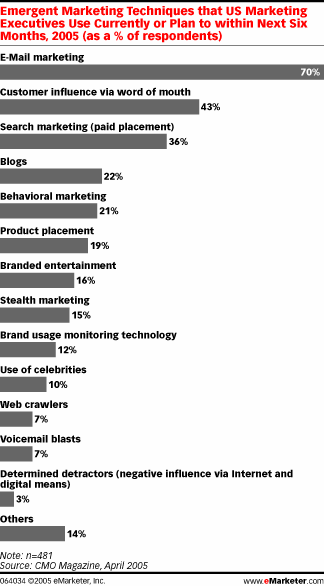
Word-of-Mouth Marketing Picks Up Speed
Published: November 03, 2005
There are dozens of metrics defining online advertising, but no one has locked down the defining numbers for word-of-mouth marketing. A new eMarketer report uncovers the "hidden statistics" of word of mouth.
Despite a long history, word of mouth as a marketing discipline is only just coming into its own, and the data indicate its best years are yet to come. eMarketer estimates that about half of all online marketers are engaging in some form of word of mouth or viral campaign, and that number will grow.
"While online advertising and all of its many subcategories such as search have dozens of metrics defining their size, shape and growth rates, no one has locked down defining numbers for word-of-mouth marketing," says Geoff Ramsey, eMarketer CEO and author of the Word of Mouth Marketing report. "It has been the 'hidden statistic.'"
Based on aggregated data from dozens of sources, as well as interviews with various word of mouth marketing experts, for the first time, eMarketer — in partnership with the Word of Mouth Marketing Association (WOMMA), uncovers the numbers behind the rumors, the facts behind the myths.
"Word of mouth has always been there, and it's always been the thing that gets us to buy," says Andy Sernovitz, CEO of WOMMA. "What's exciting is that marketers can finally do something to harness this power—and measure the results. Word of Mouth has moved from anecdotal to actionable."
Today, according to consulting giant McKinsey, approximately two-thirds of all economic activity in the US is influenced by shared opinions about a product, brand or service.
A wide variety of surveys indicate that Americans are far more likely to turn to family, friends and other personal "experts" than to use traditional media for ideas and information about products and services. In fact, RoperASW, part of GfK Group, finds that over 90% of Americans cite word of mouth as one of the best sources of ideas and information. Further, they rate "word of mouth twice as important as advertising or editorial content and put one-and-a-half times more value on it today than they did 25 years ago."
A recent UK survey conducted by Mediaedge:cia asked consumers which factors made them most comfortable when purchasing a product. More than three-quarters cited the recommendation of a friend.
Word of mouth is often referred to as "friends and family marketing," and with good reason. According to NOP (like Roper, a GfK unit), people are more likely to pass along messages via word of mouth to their friends and family members.
"The Internet has created a vast new social network of people," says Mr. Ramsey. "These online connections may be as profound as any offline relationship, such as members of health support groups, or they may be only fleeting, such as one consumer reading another's recommendation of a hotel on a travel site. But whether the connection is long or short, the person-to-person information exchanged online carries a weight that traditional corporate messaging simply can't match."
Advertising messages can be amplified by the new electronic social network. According to the Online Publishers Association (OPA), 10% of consumers who report seeing online video advertisements say they forward them on to a friend or family member — that means they were more often influencers than purchasers.
"The aggregation of the numbers gives us a powerful new lens through which we can more clearly see the entire story," says Mr. Sernovitz. "But now that word of mouth marketing is rapidly becoming part of the marketing mainstream, it faces the same big question being asked of all types of marketing: How do you measure it?"
Committed to answering that question, eMarketer and WOMMA have published the new Word of Mouth Marketing report. Take it from us, you should read it today.
22 November 2005
John Bongard
Long a corporate institution in New Zealand , appliance maker Fisher and Paykel is now well-established in Australia and expanding into Europe and the United States. CEO John Bongard describes how he approaches his trans-Tasman management task, and how the company nurtures its highly regarded innovation culture.
ceoforum.com.au: What do you see at the key challenges in managing across the Australian and New Zealand markets?
John Bongard: We see Australia and New Zealand as being our home market, so we generally look at a single Australasian market. Nevertheless, they are certainly not the same from a management point of view. One of the lessons we learnt early on was not to send over too many Kiwi managers unfamiliar with the Australian market and expect them to successfully run an Australian business. Personally, I think this is a mistake that too many New Zealand companies make when they are looking to expand into Australia.
ceoforum.com.au: What are the differences that can trip people up between the two business environments?
JB: Size, of course, is one key difference, both in revenue terms and geography. One consequence of this, for example, is that we have reasonably autonomous business units in each of the states, reporting back to our Australian head of sales and marketing. Having these autonomous business units is one thing I think that has worked very well for us in Australia.
You also need a different business infrastructure in Australia . It's a much more expensive market to operate in, the sheer size makes the logistics more complex, and the working capital requirements are much greater. This makes for a very different experience running the business.
One thing that is pretty much the same between the two mark
Long a corporate institution in New Zealand , appliance maker Fisher and Paykel is now well-established in Australia and expanding into Europe and the United States. CEO John Bongard describes how he approaches his trans-Tasman management task, and how the company nurtures its highly regarded innovation culture.
ceoforum.com.au: What do you see at the key challenges in managing across the Australian and New Zealand markets?
John Bongard: We see Australia and New Zealand as being our home market, so we generally look at a single Australasian market. Nevertheless, they are certainly not the same from a management point of view. One of the lessons we learnt early on was not to send over too many Kiwi managers unfamiliar with the Australian market and expect them to successfully run an Australian business. Personally, I think this is a mistake that too many New Zealand companies make when they are looking to expand into Australia.
ceoforum.com.au: What are the differences that can trip people up between the two business environments?
JB: Size, of course, is one key difference, both in revenue terms and geography. One consequence of this, for example, is that we have reasonably autonomous business units in each of the states, reporting back to our Australian head of sales and marketing. Having these autonomous business units is one thing I think that has worked very well for us in Australia.
You also need a different business infrastructure in Australia . It's a much more expensive market to operate in, the sheer size makes the logistics more complex, and the working capital requirements are much greater. This makes for a very different experience running the business.
One thing that is pretty much the same between the two mark"
04 November 2005
David Lazarus
Lazarus At Large Archives
President Bush asked Congress this week for $7.1 billion to prepare for a global flu epidemic that health experts believe may be imminent and would likely kill millions.
"A pandemic is a lot like a fire -- a forest fire," Bush said in a speech at the National Institutes of Health. "If caught early, it might be extinguished with limited damage. If allowed to smolder undetected, it can grow to an inferno that spreads quickly beyond our ability to control it."
Regina Phelps, a leading San Francisco emergency-management consultant, said she appreciates the president's belated attention to the matter. But she isn't encouraged.
"I don't know if our government is going to be able to do what it needs to do to meet this challenge," Phelps told me. "In light of what's happening in Iraq and the recent hurricanes, we can't look to government to save us from this.
"Businesses are going to have to rise to the occasion," she said. "It's going to have to happen on the private-sector level."
H5N1 avian influenza -- "bird flu" -- has caused 122 known human cases since December 2003. At least 62 have been fatal.
The deadly virus has already reached Europe from Asia. It's expected to arrive soon in this country. If bird flu adapts (as experts say is likely) to make human-to-human infection more common, a worldwide pandemic could erupt within months.
"I think a pandemic is inevitable," Phelps said in the cool, detached tone of someone who spends a lot of time thinking about the unimaginable. "Pandemics happen only about three times every 100 years. It seems likely that H5N1 will be the next one."
She said she's increasingly being asked by companies to help lay the groundwork for a pandemic response. She's also instructing corporate clients to begin planning now, before it's too late.
Phelps' clients include the likes of Visa, Levi Strauss, Intuit, Macromedia and the World Bank.
In 2003, she worked with Stanford University on a training exercise that simulated an outbreak of highly infectious pneumonic plague on the Palo Alto campus. The elaborate drill was meant to prepare for a terrorist attack or a flu pandemic.
In the United States, Phelps predicted an outbreak of bird flu among humans would kill between 500,000 and 2 million people. Globally, perhaps as many as 200 million could die.
Phelps' projections for U.S. fatalities are in line with figures released by the White House on Wednesday.
"We could be facing the greatest disaster of our lifetime," she said.
50 million died
By comparison, the 1918 Spanish flu pandemic killed an estimated 50 million people worldwide, including 550,000 in this country. And this was before air travel allowed viruses to hop continents in just a matter of hours.
Sherry Cooper, chief economist at Toronto investment firm BMO Nesbitt Burns, said in a report last month that ordinary flu outbreaks each year cost the U.S. economy as much as $12 billion in medical expenses and lost productivity.
A flu pandemic, she warned, would have an economic impact of up to $167 billion on the United States and perhaps a more disastrous financial impact on other nations.
"The repercussions on global trade would be devastating," Cooper wrote. "Given that virtually all major economies have a surplus with the (United States), trade disruptions would shutter manufacturing plants and curtail global demand for most commodities."
Meanwhile, the Asian Development Bank said Thursday that a flu pandemic could kill 3 million people in Asia and cost regional economies almost $300 billion. "Growth in Asia would virtually stop," the bank predicted.
So what should we be doing?
On the individual level, health experts strongly advocate proven methods to fight the spread of viruses: frequent hand washing, along with routine cleansing of surfaces and equipment shared by others.
For companies, Phelps is warning clients to prepare for as much as a third of their workforce being out sick at any one time. Similar absenteeism will be experienced by vendors and other business partners (not to mention multitudes of customers being stricken or avoiding stores and other public places).
Phelps says employers need to closely monitor workers' health to stay ahead of a fast-moving outbreak. If a pandemic appears likely, face-to-face meetings should be all but eliminated in favor of conference calls and online discussions.
Companies will need plans in place to deal with a worker who becomes seriously ill on the job and to disseminate information among employees as rapidly as possible.
Working from home
Ailing workers must be required to stay home. But for companies to remain operational, Phelps says all "mission critical" employees must be provided in advance with desktop computers in their homes, broadband connections and all necessary supplies.
She knows that few companies have either the financial resources or the wherewithal for such a move. But Phelps says the contingency of what she calls "robust work from home" can make all the difference in allowing a company to ride out a major emergency.
"It's a great strategy if we're trying to recover from an earthquake," she said. "It's really great if we're trying to recover from a pandemic."
As it stands, Phelps believes the disruption to business caused by a pandemic would almost certainly plunge the world into a global recession.
"There are going to be a lot of companies that won't survive this," she said.
Phelps acknowledges that there will be people who won't want to even discuss the prospect of a pandemic because of the enormity of the consequences. Denial is a common response in her line of work.
"I have a pretty bizarre job," she observed. "I spend my time thinking about things that horrify people. But I work on what to do about them."
Should we be frightened?
"We should definitely be frightened," Phelps replied without hesitation. Then she reconsidered.
"Maybe that's too strong a word," she said. "Fear prevents activity. It renders people impotent."
Well, at least the president has requested billions of dollars to help us get ready.
Phelps was silent a moment.
"I don't know if $7 billion is going to be enough," she said softly. "We have so much to do."
Transform your workplace with conversations that encourage staff to be accountable and committed to the change process.
Transformation occurs through choice, not mandate. An invitation is the call to create an alternative future. What is the invitation that we can make to support people to participate and own the relationships, tasks, and process that lead to change and success?
The key could lie in six conversations that we can have to effect positive change while creating accountability and commitment by all participants. The conversations are based on the belief that all change and transformation is linguistic in nature.
Also, it is believed that focusing on people's potential and their best nature is much better than solving problems of the past or people's deficits. Another premise is that by having these conversations, we can create a community that helps organisations succeed beyond average performance.
Below are the six conversations as well as the role that the leader should play in order to facilitate the process of change.
1. The Invitation Conversation
The invitation must contain a hurdle or demand if accepted. It is a challenge to engage. Most leadership initiatives or training are about how we get or 'enrol' people to do tasks and feel good about doing things they may not want to do. People need to 'self-enrol' in order to experience their freedom of choice and commitment.
The leadership task is to name the debate, issue the invitation, and invest in those who choose to show up. Those who accept the call will bring the next circle of people into the conversation.
2. The Ownership Conversation
This conversation begins with the question: "How have I contributed to creating the current reality?"
Confusion, blame and waiting for someone else to change are a defence against ownership and personal power. The enemy of ownership is innocence and indifference. The future is denied with the response: "It doesn't matter to me. Whatever you want to do is fine."
Such a statement is always a lie and just a polite way of avoiding a difficult conversation about ownership.
People best create that which they own and co-creation is the bedrock of accountability. It is the belief that I am the cause, not the effect. The leadership task is to confront people with their freedom.
3. The Possibility Conversation
This focuses on what we want our future to be as opposed to problem-solving the past. This is based on an understanding that living systems are really propelled towards the future.
The possibility conversation frees people to innovate, challenge the status quo, and create new futures that make a difference.
In new work environments, this conversation has the ability for breaking new ground and in understanding the prevailing culture.
Problem-solving and negotiation of interests makes tomorrow only a little different from yesterday. Possibility is a break from the past and opens the space for a future we had only dreamed of. Declaring a possibility wholeheartedly is the transformation.
The leadership task is to postpone problem solving and stay focused on possibility until it is spoken with resonance and passion.
4. The Dissent Conversation
This allows people the space to say 'no'. If we cannot say 'no', then our 'yes' has no meaning. People have a chance to express their doubts and reservations as a way of clarifying their roles, needs, and yearnings within the vision and mission being presented.
Genuine commitment begins with doubt, and 'no' is a symbolic expression of people finding their space and role in the strategy. It is when we fully understand what people do not want that we can fully design what they want. Refusal is the foundation for commitment.
The leadership task is to surface doubts and dissent without having an answer to every question.
5. The Commitment Conversation
This is about individuals making promises to their peers about their contribution to the success of the whole organisation.
It is centred in two questions: What promise am I willing to make to this enterprise? And what is the price I am willing to pay for the success of the whole effort? It is a promise for the sake of a larger purpose, not for the sake of personal return.
The leadership task is to reject lip service and demand either authentic commitment or ask people to say no and pass. We need the commitment of much fewer people than we thought to create the future we have in mind.
6. The Gifts Conversation
What are the gifts and assets we bring to the enterprise? Rather than focus on our deficiencies and weaknesses, which will most likely not go away, focus on the gifts we bring and capitalise on those. Instead of seeing problems in people and work, the conversation is about searching for the mystery that brings the highest achievement and success in work organisations.
Confront people with their essential core that has the potential to make the difference and change lives for good. This resolves the unnatural separation between work and life.
The leadership task is to bring the gifts of those on the margin into the centre.
by Geoff Ramsey, Friday, Sep 23, 2005 6:00 AM EST
THE INTERNET PROVIDES SO MANY ways for users to spread information in ways never before possible. E-mail, for example, can easily extend the reach of someone's brand by a factor of 10, 100, 1,000 or over 10,000. The Internet also serves as a vast digital repository of such information -- accessible at any time, from anywhere and by anyone. Millions of opinions about your company's brand are only a click away on search engines, blogs, product ratings sites, podcasts and other digital platforms. The immediacy of the Internet is giving way to more word-of-mouth marketing and viral campaigns. Below are eMarketer's top ten reasons for the explosive growth of word-of mouth marketing, and why we feel it will continue to be a major factor in consumers' and companies' lives.
#1. The consumer is in control. It's hardly a news flash, but consumers today have unprecedented control over their media and content. Using everything from MP3 players to blogs, Blackberries, podcasts, digital video recorders and search, consumers are accessing information when they want it, where they want it and how they want it. According to Pew Internet & American Life Project, 44 percent of online U.S. adults, or over 50 million Americans, are "content creators," meaning that they contribute in some way to the Internet, such as via blogs, podcasts and product recommendations and reviews. Factor in the word-of-mouth effect through these communication channels and you see the cascading effect right across the top.
#2. Growing Distrust of Advertising Messages More and more Internet users are moving away from "manufactured" messages to instead trust the opinions of others, including friends, family, co-workers, etc. A recent Intelliseek study revealed that 88 percent of consumers trust "advertising" via word of mouth. In contrast, only 56 percent said newspapers were trustworthy, 47 percent said the same for television and radio, and even search was trusted by only 34 percent. Yankelovich also noted that only 27 percent of consumers polled trust experts and 8 percent trust celebrities, but a whopping 65 percent of consumers trust friends for product recommendations. Accordingly, for marketers looking to bolster the trust factor with their brands (and who isn't?), almost nothing beats word of mouth.
#3. Empowered consumers are fighting back! An astounding 87 million Americans have signed up for the national "Do-Not-Call" registry. About one-fifth of consumers use spam and online ad blockers. Next year, over 15 percent of households will be equipped with TiVos and other kinds of digital video recorders for the primary purpose of skipping over television ads. Faced with this emotional and mounting resistance, marketers must find news ways to connect with consumers, or, as some have put it, "join in the conversation." Word of mouth provides marketers with unique opportunities to do just that. Consumers will willingly share ad messages -- as long as they are entertaining, informative or otherwise compelling -- with others.
#4. Increased spending behind interactive advertising.eMarketer projects spending on online advertising in 2005 will rise 34 percent, far above the growth rate of any other single medium. A big reason for the growth in interactive advertising is the desire among marketers to exploit viral and other forms of word-of mouth-opportunities. With corporate marketing budgets increasingly opening up to interactive platforms, marketers are taking a fresh look at viral and word-of-mouth strategies, which typically involve the Internet and e-mail.
#5. Emphasis on targeting and relevance in ad campaigns. Marketers are finding that the secret to successful viral campaigns is to create advertising that is so interesting, entertaining or otherwise engaging that consumers will invite you in their front door, and invite all their friends and family as well. There is a shift underway in content models, from ad-supported mass channels to user-supported niche content. Marketers can participate in this evolution by creating valuable content of their own. In this world of fragmented media and consumer personalization, marketers are shifting their focus from mass to targeting efforts.
#6. E-mail and other platforms ease use of viral programs. Many examples abound for the successful use of e-mail in creating viral campaigns. Procter & Gamble used e-mail to create a viral campaign for its new Tide Coldwater launch, a product designed to help conserve the environment. According to data from Hitwise, the e-mail campaign increased traffic at the Tide Coldwater site by 900 percent in the first week, and then tripled that level in week two.
However, marketers trying to stimulate viral behavior should not restrict their focus entirely to e-mail and the Internet. Because e-mail viral campaigns are so inexpensive to deploy, it is critical that marketers invest a considerable amount of thought and creativity before shooting messages out to consumers. While Jupiter reports that 34 percent of marketers had tried viral campaigns as of October 2004, only 10 percent of consumers surveyed had forwarded an e-mail as a result of seeing an ad. The emphasis, therefore, should be on quality, not quantity.
#7. Word of mouth/viral marketing are relatively inexpensive to deploy.One fascinating aspect of word-of-mouth marketing is that consumers end up doing much of the heavy lifting -- communicating about your product or brand to others -- so that communication costs are in effect being 'subsidized.'
Borla, a manufacturer of exhaust systems, experimented with an e-mail-driven viral video campaign and achieved success. For about the same cost of a four-color, full-page print ad in a sports car magazine ($16,700), Borla was able to achieve significant, measurable and cost-effective results. The ads used risqué humor to spur people to view and pass the video along.
#8. Accountability and measurement. New companies and technologies have emerged to figure out how to measure and track word-of-mouth marketing campaigns. BuzzMetrics, for example, has software that can measure brand awareness among a large population of online consumers, as well as rank major topics of conversations in the blogosphere. Similarly, Intelliseek uses software that sifts through blogs to document and organize what consumers are saying to each other about various products and brands. Mazda used this service to find out how to structure a public relations campaign around the launch of its RX-8 model.
#9. The "Energizer Bunny" effect. One of the side benefits of word-of-mouth, and particularly viral, campaigns, is the opportunity for marketers to milk their campaigns over time, extending not only their reach but also their duration. A year and a half after the "Subservient Chicken" campaign was launched, it is still getting hits, and still being talked about.
#10. Word-of-mouth marketing has a ripple effect on other media. Word-of-mouth campaigns generate after-effects that can give your marketing programs more "spin" for the money. In many cases, viral campaigns can significantly extend your reach while reinforcing your message among a core group of target consumers. For example, a television spot on the Super Bowl will get relaye and talked about in thousands of blog conversations, with both positive and negative comments. An arresting or highly unusual ad campaign delivered on any medium is likely to be picked up by the blogosphere, providing it with more traction.
Geoff Ramsey is co-founder and chief executive officer of the Internet research firm eMarketer.
31 October 2005
Government teams with Intel to build largest testing ground for new wireless technology.
Dan Nystedt, IDG News Service
Tuesday, October 18, 2005
TAIPEI -- Taiwanese government officials said on Monday they plan to make Taiwan the world's largest testing ground for WiMax, and inked a pact with Intel to work together on the wireless broadband technology.
The government will provide around $209 million in funding for the initiative, in addition to spectrum allocation and other assistance, while Intel is expected to pitch in its technical resources. Next year, the government will provide an additional $32.8 million in research funds specifically for WiMax, a separate budget from the above figure, said Minister of State Lin Ferng-ching.
Notebooks Ready
WiMax, also known as 802.16, is intended to provide users with wireless, high-speed Internet access at far greater distances than the current mainstream wireless technology, Wi-Fi.
Taiwan hopes to become a leader in developing products for WiMax, such as PC cards and notebook computers, as well as broadband services, by making itself a leader in the technology, according to Ho Mei-yueh, Taiwan's economics minister.
Taiwan chose to team up with Intel because the chip maker is among the staunchest proponents of WiMax and alre"
PDF Print E-mail
Written by Rita Jenkins| 27 October, 2005 19:18 GMT
a d v e r t i s e m e n t
HapMap haplotypes genetic research human evolution
'Data from the HapMap project allows scientists to select the particular DNA variants that provide the greatest information in the most efficient manner, lowering the costs and increasing the power of genetic research to identify the origin of disease.' Genetic researchers have made substantial advances in understanding the root causes of common diseases and the history of human evolution, according to a series of reports published in scientific journals this week.
Chief among these accomplishments is the work of an international consortium of more than 200 scientists from Canada, China, Japan, Nigeria, the United Kingdom and the United States published in the October 27 issue of the journal Nature.
The team studied DNA samples from four different parts of the world and concluded that genetic variants located physically close to each other are inherited collectively as groups, called haplotypes. The comprehensive catalog of all of these blocks is known as the 'HapMap.'
'Built upon the foundation laid by the human genome sequence, the HapMap is a powerful new tool for exploring the root causes of"
30 October 2005
Gareth Walsh
SCIENTISTS have made a breakthrough in cell research that they believe brings the prospect of drastic improvements in the treatment of diseases such as Parkinson’s and multiple sclerosis.
According to reports yesterday they have discovered the chemical trigger that causes stem cells from embryos to start developing into organs, raising the possibility of parts of the body being able to repair their own damage.
Scientists have already established that the stem cells found in embryos have the capacity to develop into all other types of human cell. Until now they have been unable to find the correct chemical mix to spur them artificially into changing into endoderm, the layer of cells in embryos that in turn gives rise to organs.
Researchers at CyThera, an American company, announced last week in Nature Biotechnology, the scientific journal, that they had developed a technique to produce highly enriched endoderm cultures. Their research proves that embryonic stem cells have the capacity to change in the laboratory into endoderm.
Emmanuel Baetge, scientific director of CyThera, said: “If you were to use human embryonic stem cells to make products that treat disease such as diabetes or liver failure, you would have to go through the endoderm stage to get (them).”
The CyThera research team described its work as “a critical step in generating scientifically and therapeutically useful cells”. It has also been hailed by colleagues who say that endoderm is notoriously difficult to obtain.
14 August 2005
Mark Lawson: Because of your invention, I was able to look up every article written by or about you quickly and easily. But at the same time, I was sent several unsolicited links to porn sites. I have to accept that someone in Mexico may have stolen my identity and now be using it. Is the latter absolutely worth paying for the former? 
Tim Berners-Lee: That's an interesting question that you ask, as though it's a yes or no answer. As though our choice is to turn off the whole thing, or turn on the whole thing. I feel that the web should be something, which basically doesn't try to coerce people into putting particular sorts of things on it.
I feel that we need to individually work on putting good things on it, finding ways to protect ourselves from accidentally finding the bad stuff, and that at the end of the day, a lot of the problems of bad information out there, things that you don't like, are problems with humanity.
This is humanity which is communicating over the web, just as it's communicating over so many other different media. I think it's a more complicated question we have to; first of all, make it a universal medium, and secondly we have to work to make sure that that it supports the sort of society that we want to build on top of it.
ML: When you think in terms of what it has allowed, what is the achievement of the web? 


TBL: It's a new medium, it's a universal medium and it's not itself a medium which inherently makes people do good things, or bad things. It allows people to do what they want to do more efficiently. It allows people to exist in an information space which doesn't know geographical boundaries. My hope is that it'll be very positive in bringing people together around the planet, because it'll make communication between different countries more possible.
But on the other hand I see it as a substrate for humanity, I see it as something on which humanity will do what humanity does and the questions as to what we as individuals and we collectively do, are still just as important and just as much as before, up to us.
ML: But do you feel responsible? You say humanity will do whatever it does with it, do you feel responsible for what happens?
TBL: I do not feel responsible for everything that humanity does, no. I suppose I feel a responsibility when people take on the web expecting one thing and get something else, so yes I suppose that's partly why I'm involved with the World Wide Web Consortium, and lots of other people are trying to make it better.
Towards a rewritable web
ML: I'm interested that at what sense you began to sense the possibilities. You weren't thinking car rental, you weren't thinking blogging, I assume.
TBL: Well in some ways. The idea was that anybody who used the web would have a space where they could write and so the first browser was an editor, it was a writer as well as a reader. Every person who used the web had the ability to write something. It was very easy to make a new web page and comment on what somebody else had written, which is very much what blogging is about.
For years I had been trying to address the fact that the web for most people wasn't a creative space; there were other editors, but editing web pages became difficult and complicated for people. What happened with blogs and with wikis, these editable web spaces, was that they became much more simple. 
When you write a blog, you don't write complicated hypertext, you just write text, so I'm very, very happy to see that now it's gone in the direction of becoming more of a creative medium.
ML: Moving on to the consequences and the uses of the internet, the first question that arises a lot is the quality, the reliability of the information that is there. Now some people think that the internet has led to this great empire of lies, of unreliability. You simply don't know what the state of any of this information is.
TBL : When you say there are a lot of lies out there, if you go randomly picking up pieces of paper in the street or leafing through garbage at the garbage dump what are the chances you'll find something reliable written on the paper that you find there? Very small. When you go onto the internet, if you really rummage around randomly then how do you hope to find something of any of value?
But when you use the web, you follow links and you should keep bookmarks of the places where following links turns out to be a good idea. When you go to a site and it gives you pointers to places that you find are horrible or unreliable, then don't go there again.
You see out there right now, for example, when you look at bloggers some of them are very careful. A good blogger when he says that something's happened will have a point to back, and there's a certain ethos within the blogging community, you always point to your source, you point all the way back to the original article. If you're looking at something and you don't know where it comes from, if there's no pointer to the source, you can ignore it.
Powerful tool
ML: You must reflect though on the law of unintended consequences because it wasn't remotely ever your intention when you started on this that so much of the web would be given over to sexual exhibitionists masturbating in their bedrooms with webcams. Do you ever have bad moments about that?
TBL: Well I don't see that stuff.
ML: But you know it's there though?
TBL: Some people tell me. I suppose the question is to what extent the people use it for things which should seriously concern us. For example, are people using the web to get information about how to do illegal things, whether it's to make explosives, how to kill people, poison people, or whatever it is. So there's a certain amount of danger that this tool can be used for bad purposes. It's a very powerful tool.
ML: And you've never had a sleepless night over that?
TBL: No I haven't. I haven't had a sleepless night over it because I suppose I'm so much more surrounded by the good things that people are doing with it. There are lots of positive stories of people doing great things, putting educational information out there for people in developing countries and things, for example. There's a huge spirit of goodness. Most of the people I meet who are developing the web are focused on all those things.
ML: You have a convenient benchmark, because you have a daughter who was born just as the web was beginning. Her stages of development are the same as the web in years. So, when she is 30, say, what would you want the web at 30 to be?
TBL: People often quite successfully compare the web with a growing person, and it's certainly had its years of adolescence when it's been trying to push the boundaries, see how far we can go, and I think some of these things, with spam and phishing that we see at the moment are examples of that. And people have been pushing backwards and forwards about piracy, and I think a lot of those things will settle down.
When it's 30, I expect it to be much more stable, something that people don't talk about. Really when you talk about an article, you don't say, "Oh, I'm going to write an article on paper!" The fact that we use pen and paper is sort of rather understood.
Similarly the web will be, hopefully, will be something which is sunk into the background as an assumption. Now, if as technologists develop, we've done our job well, the web will be this universal medium, which will be very, very flexible. It won't, itself, have any preconceived notions about what's built on top.
One of the reasons that I want to keep it open like that, is partly because I want humanity to have it as a clean slate. My goal for the web in 30 years is to be the platform which has led to the building of something very new and special, which we can't imagine now.
ML: Tim Berners-Lee, thank you very much.
08 July 2005
26 June 2005
rixome is a locative media project. This research area tries to make a social, glolocal and ibiquitious use of technology, going far away from usual individual and un-localizable interfaces."
The results achieved by the team from the Department of Electronic Systems Engineering are the equivalent of more than 162,000 phone calls or over 10,000 broadband internet connections being made simultaneously. Such large capacity could revolutionise wireless internet download times for many households and local businesses, small and large.
While the techniques used by the Essex group don%u2019t fit exactly to the MultiBand Alliance template in the IEEE (Institute of Electrical and Electronics Engineers) 802.15 ultra-wideband radio standardisation process, they are important because they show that 10 Gigabit radio is feasible. The successful experiment at Essex demonstrates that far greater capacity could be obtained from present generation wireless links given appropriate standardisation.
The Essex Department of Electronics Systems Engineering is one of the strongest in the country, and currently has a grade 5 rating for carrying out research of national and international excellence. In 2001, researchers in the department achieved a world record for the amount of computer data sent over a single multimode optical fibre, which won them a slot in the Guinness Book of Records.
The latest record-breaking results came at the end of a two-year project by MSc student Terry Quinlan, part of precursor work which will be further enhanced by a recently-announced ?1 million Higher Education Funding Council for England equipment award. Eventually, the mm-wave region could be used where even higher data rates may be possible.
Head of the Essex project, Professor Stuart Walker, said: %u2019This achievement represents the culmination of many months of painstaking work. Multigigabit transmission systems of any sort require really detailed design and wireless is no exception. The original aim was just to investigate the performance of cheap flat patch antennas. We were pleasantly surprised by the initial results and kept on improving the experimental set-up. "
2005UPDATED: 4:07 pm EDT June 23,
2005CHICAGO -- Researchers have developed artificial arms that can be moved as it if they were real limbs, simply by thinking about making them move, according to Local 6 News. When Jesse Sullivan's brain tells his arm to do something, it's done in seconds.The world's first bionic man, Jesse Sullivan, 54, accidentally touched live wires while working as a utility lineman in Tennessee. He suffered severe burns, causing him to lose his arms."
15:25 24 June 2005
NewScientist.com news service
Will Knight Billions of tiny mechanical levers could be used to store songs on future MP3 players and pictures on digital cameras.
As bizarre as the idea might sound, researchers at a Dutch company have already demonstrated that miniscule mechanical switches can be used to store data using less power than existing technologies and with greater reliability.
Nanomech memory, developed by Cavendish Kinetics in the Netherlands, stores data using thousands of electro-mechanical switches that are toggled up or down to represent either a one or zero as a binary bit. Each switch is a few microns long and less than a micron wide - roughly a hundred times smaller than the width of a human hair.
Existing computer memory typically stores data as an electrical or magnetic charge. Cavendish Kinetics claims Nanomech memory can read and write data using 100 times less power than such systems, and works up to 1000 times faster. It is also much more resilient to both temperature and radiation, the company claims.
Intermolecular forces
Nanomech memory incorporates hundreds of thousands of conductive metal levers, each just a few microns long. These are created by lithographically etching a design onto a template and then chemically dissolving away unwanted layers."
14 June 2005
All Products Listed by Ranking"
By Stephen Withers, Technology & Business magazine
10 June 2005
In 10 years almost everything will be tagged, say the experts. So what are these little chips that are soon to be so pervasive, and how will they take over your business?"

 Posts
Posts


